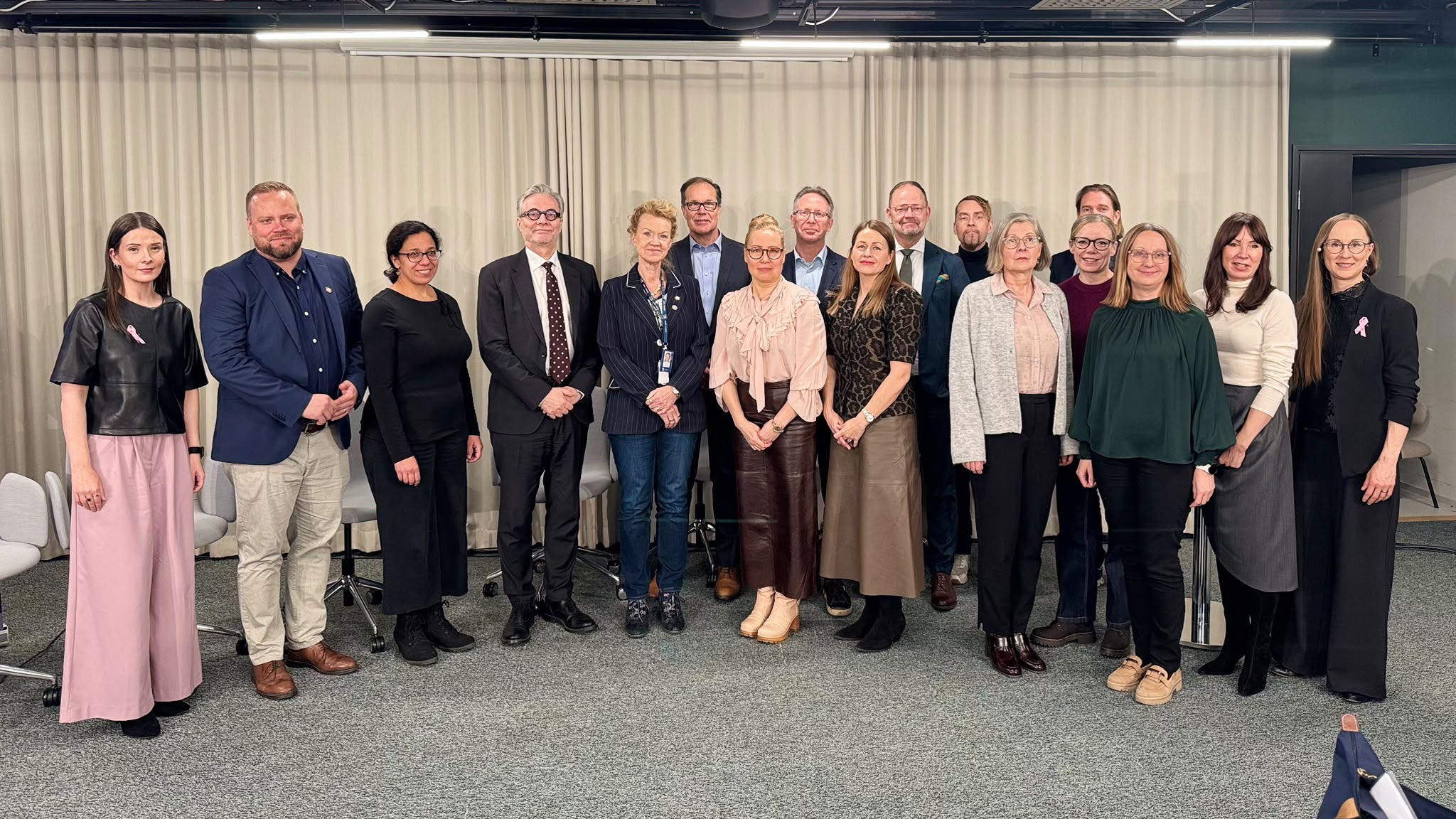
The event was opened by the Minister of Social Affairs and Health, Wille Rydman. In his opening speech, Rydman described the background and aims of the National Cancer Strategy and its implementation roadmap, and noted that the suggested initial investment of 139 million euros for implementation would result in savings long-term.
Markku Mäkijärvi — long-time Chief Medical Officer at HUS, who retired in June, and who served as chair in both the FICAN national management board and the steering group for the National Cancer Strategy — reviewed the various stages of the cancer strategy process, from initial planning to roadmap implementation. Mäkijärvi has played a significant role in the production of the strategy and its roadmap; a sincere thanks to him for this!
From strategy to concrete implementation
The start of the event featured practical examples from across Finland of projects and operational models that advance the goals of the National Cancer Strategy. Specialist Sanna Iivanainen, Director of FICAN North, discussed the national lung cancer screening pilot; Specialist Satu Tiainen, Director of FICAN East, spoke about the promotion of clinical cancer drug trials in the Eastern collaborative region; and Chief Physician Katriina Jalkanen provided an update on the personalized medicine focused FINPROVE and FINACCESS studies. Eva-Maria Strömsholm, Vice Chair of Gynecological Cancer Patients in Finland, shared developments from the Ostrobothnia wellbeing services county, where a regional cancer strategy monitoring group has been established following a council initiative. These examples serve as excellent evidence of how the strategy’s objectives can be advanced at the regional level through various projects, research initiatives, and the development of operations.
Cancer data supports impact, development and research
The second section of the day focused on cancer-related data as part of information management in the social and health care sector. In his presentation, Tomi Malmström, Deputy Director General of Information at the Finnish Institute for Health and Welfare (THL), highlighted challenges in social and health care information management: data remains fragmented, documentation practices and quality vary, the same information is collected multiple times, and the division of responsibilities is unclear. These challenges must be addressed in the near future, and artificial intelligence offers potential solutions in this regard. The quality registry project — a collaboration between FICAN, the Finnish Cancer Registry, and THL — has yielded new insights into treatment outcomes and data quality for lung cancer and myeloma; the next areas of focus will be prostate, breast, and colorectal cancers. The quality registry project is set to conclude in 2027.
“The goal of quality registry activities is better treatment outcomes, as well as more equitable and cost-effective care. The continuity of quality registry work in oncology is important to THL,” stated Malmström.
The theme of data management continued in a panel discussion, which examined the utilization of data in areas such as impact assessment, peer-based development and research. In addition to Malmström, the panel featured Professor Kimmo Porkka (HUS/University of Helsinki), Director Nadia Tamminen (Pharma Industry Finland), Director Janne Pitkäniemi (Finnish Cancer Registry), and Chief of Division Annika Ålgars (Turku University Hospital).
How to ensure cancer strategy implementation?
Heidi Hammarsten, Editor-in-Chief of the Rinnakkain magazine, brought a patient perspective to the cancer strategy, emphasizing the importance of the patient viewpoint both in research and in the broader implementation of the strategy. In a panel discussion, Chair of the FICAN national management board and Service Area Director Hanne Kuitunen (Oulu University Hospital) along with Juha Pekka Turunen (Cancer Society of Finland), Members of Parliament Aki Lindén (SDP) and Sari Sarkomaa (National Coalition Party), and director Tuula Helander (Ministry of Social Affairs and Health) discussed how to ensure a nationally consistent and adequately resourced implementation of the cancer strategy. While some measures can be carried out by improving guidance and management, others will inevitably require additional resources for the wellbeing services counties and other entities responsible for implementation. All the panelists expressed their support for including the cancer strategy in the next government program.
National collaboration to be strengthened through NCMH Finland
To end the afternoon, Project Manager Martin Jansson from Socialstyrelsen presented the experiences of cancer field collaboration from Sweden. At the Swedish NCMH SweCan, which currently comprises of 57 organizations from different sectors of the cancer field, cancer is viewed broadly as a societal challenge. Following this, Project Manager Mirjami Tran Minh from the FICAN coordinating unit presented on the launch of the Finnish NCMH and the current call for membership applications.
“We are hoping to receive applications from a wide range of stakeholders from the cancer field. The goal is to further cancer strategy implementation in the form of broad collaboration”, encourages Tran Minh.
Collaboration to reach the goals of the National Cancer Strategy therefore continues. Thank you to the all speakers, panelists and participants who took part in the event!
The event was hosted by director Tomi Mäkelä, Senior Planning Specialist Outi Nikunen, Project Managers Sauli Vuoti and Mirjami Tran Minh, as well as Chief Physician Ilkka Liikanen from the FICAN coordinating unit.
